

Ryzen 5000 review: AMD wins big in laptops - riveracamortautley
AMD's inexperient Ryzen 5000 mobile CPU has arrived with a bang. Its predecessor, Ryzen 4000, reset the bar for what to expect from laptop computer performance. But AMD's not nearly finished.
With the Ryzen 9 5980HS, AMD has burst an even more powerful Mainframe into a 13-column inch, 3-pound convertible laptop that simply hammers competitors that weigh doubly as much. Read on to instruct more about how it operates in the bran-new Asus ROG Flow X13.
What is Ryzen 5000 mobile?
Ryzen 5000 maneuverable differs from AMD's desktop chipsets because IT's a purpose-designed monolithic die comprising the latest Zen 3 cores, somewhat developed graphics, a better memory controller, and power-focused improvements. The Ryzen 5000 line of CPUs is built connected TSMC's 7nm process.
The CPU isn't exactly new, for the simple reason that the company designed Ryzen 5000 CPUs to equal pin-sympathetic with the previous Ryzen 4000 motherboards used in laptops. That requirement does limit how crazy AMD could get with the new chip. Still, the inexperienced Zen 3 cores do not disappoint one bit.
 AMD
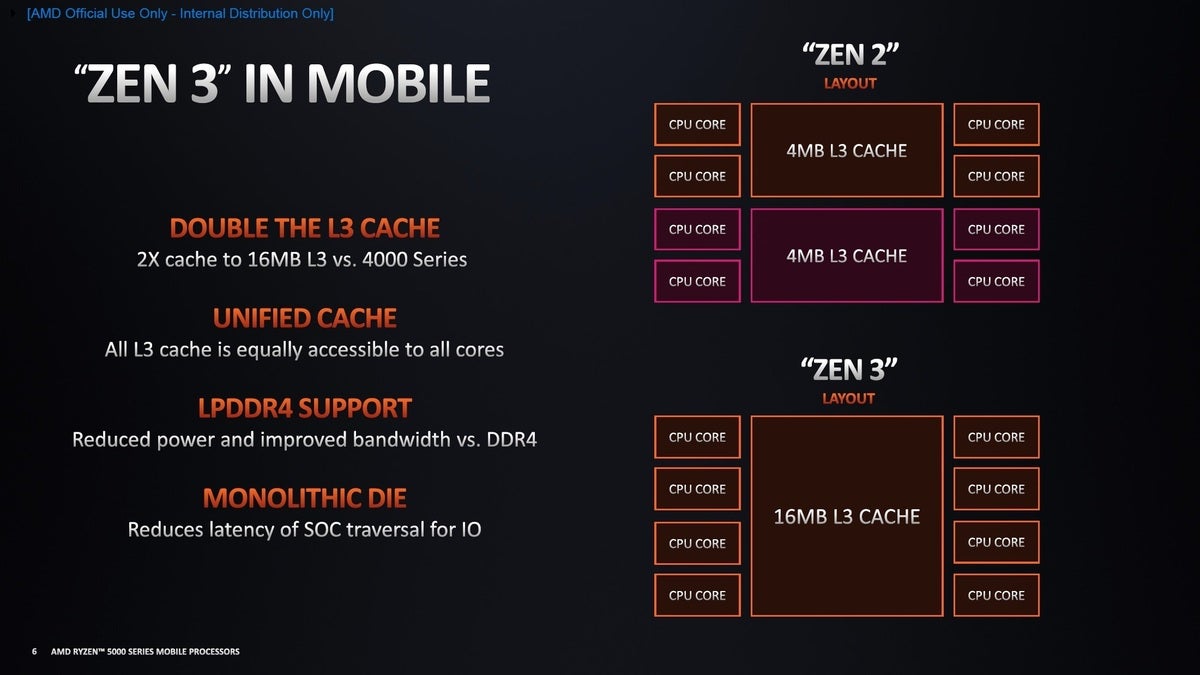
AMD One of the major changes between the Zen 2 cores in Ryzen 4000 and the Back breaker 3 cores in Ryzen 5000 was the place level of cores in a Core Chiplet Die (CCD), which increased from four to octonary cores. Like the background version, that meant all eight cores would ingest access to the same L3 cache. With Ryzen 4000, four cores shared 4MB of cache with another four cores that had their own separate cache, a more inconvenient arrangement that slowed performance.
Zen 3 also doubles the size of it of the cache from 8MB to 16GB. It may non be the massive 32MB of L3 cache the desktop Zen 3 CPUs feature, simply information technology's a sizeable increase.
The Zen 3 cores themselves are major redesigns intended to eliminate inefficiencies in the previous Zen cores. AMD's goal is to counterbalance Intel's lonesome leftover reward in lightly-threaded and single-threaded tasks.
 Gordon Mah Ung
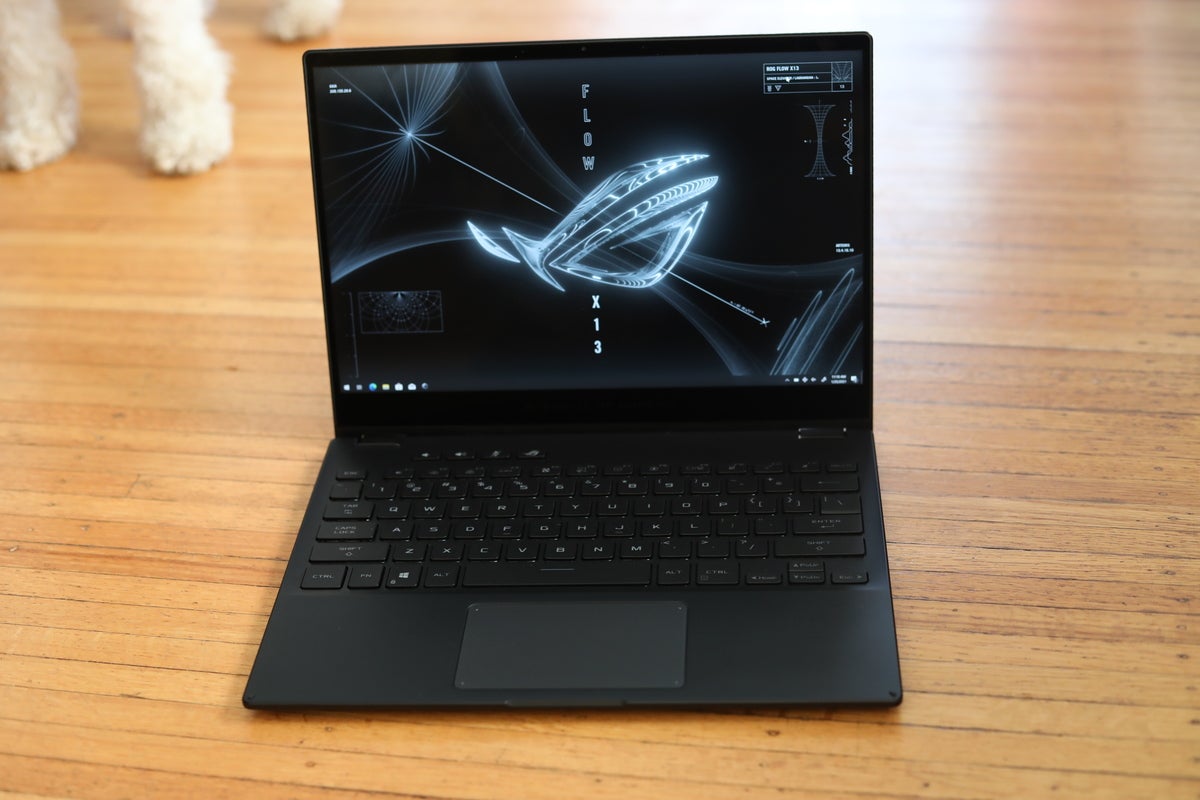
 The Asus ROG Flowing X13 weighs Eastern Samoa much as an XPS 13 2-in-1 yet features an 8-core Ryzen 9 5980HS, GeForce GTX 1650 and pot be paired with a GeForce RTX 3080.
Bend-your-brainiac time
For our review of Ryzen 5000, we were conferred memory access to an Asus ROG Flow X13 laptop. It's a 2.9-pound, ultraportable laptop featuring a cover girl 16:10 aspect-ratio 4K+ screen, touchscreen, pen, and a 360-degree transformable hinge.
You'd carry a laptop that converted into pad of paper operating room A-frame to be a sedate mock up made for web-browse, Office productivity, and observation videos. The Brobdingnagian majority of such convertibles are paired with Intel's powerless "U-class" CPUs, non those "H-class" CPUs reserved for burly gaming laptops that weight fin to eight pounds.
We make seen very much of Mainframe and GPU power in a light laptop before. MSI's yr-old Prestigiousness 14 impressively featured a 6-substance Comet Lake U CPU and GeForce GTX 1650 Max-Q. The problem was designing it to weigh to a lesser degree trio pounds, which led to a lot of compromises in cooling.
Not so inside of the Asus ROG Flow X13. AMD's Ryzen 9 5980HS is a 35-watt "high efficiency" version of the Mainframe. Care the Prestige 14, the ROG Flow rate X13 features a GeForce GTX 1650 Max-Q GPU, but it besides has a portable eGPU featuring a custom Nvidia GeForce RTX 3080. Information technology connects to the Flow X13 using a custom x8 PCIe Gen 3.0 connecter.
Alas for today's review, the eGPU was involved in customs, thusly you won't see the gaming chops of the Flow X13 just yet. Fortunately, if you really just want to know if the Ryzen 5000 can live upwards to its purpose, you nates.
What we compared to Ryzen 5000
Extraordinary matter all singular person should call back is laptop computer CPUs are part of a package. You don't buy the Central processing unit and build your laptop computer—you get the laptop with all of the parts installed, most permanently. In other words: You can't isolate motile CPU performance, because it's inextricable from the weight and figure of the laptop, and especially the cooling system in the laptop computer.
Normally, for example, we wouldn't think it fair to compare a typical 5-pound H-separate Central processor against a 3-pound U-class convertible laptop computer. With the ROG Flip X13, though, you actually have to.
- MSI's Prestige 14 EvoRemove non-product inter-group communication is equipped with a 4-core, 11th-gen Core i7-1185G7 with Iris Xe graphics, 16GB of LPDDR4X/4267 memory, a 512GB PCIe Gen 4 SSD, and a 14-inch FHD test. It weighs 2.7 pounds.
- MSI's older Prestige 14 is equipped with a 6-core, 10th-gen Marrow i7-10710U, GeForce GTX 1650 Soap-Q graphics, 16GB of LPDDR3/2133 remembering, a 1TB PCIe 3.0 SSD, and a 14-inch 4K screen. It weighs 2.8 pounds.
- Lenovo's Yoga Slim 7 has an 8-core Ryzen 4800U with Radeon graphics, 16GB of LPDDR4X/4267 memory, a 512GB PCIe 3.0 SSD, a 14-inch FHD, and lap weight of 3.1 pounds.
- The Asus ROG Zephyrus G14 includes an 8-core Ryzen 9 4900HS (sometimes mistyped as '4800HS' in the charts that observe), GeForce RTX 2060 Max-Q graphics, 16GB of DDR4/3200 memory, a 1TB PCIe 3.0 SSD, a 14-in FHD screen, and a weight of 3.6 pounds.
- The Acer Predator Triton 500 comes with a 6-core 10th-gen Core i7-10750H CPU, GeForce RTX 2080 Superintendent Max-Q nontextual matter, 32GB of DDR4/3200 memory, a 1TB PCIe 3.0 SSD, and a 15.6-inch 300Hz FHD screen. IT weighs 4.6 pounds.
- Gigabyte's brand new Aorus 17 sports an 8-marrow, 10th-gen Core i7-10870H CPU, GeForce RTX 3080 max-Q, 32GB of Crash, and a 17.3-inch 300Hz FHD screen. Information technology weights 6 pounds.
This extract gives us a pretty healthy mix of Ryzen 4000H and Ryzen 4000U, as well as 11th-gen Intel U-sort CPUs and 10th-gen Intel H-CPUs. The GPUs count too, and we'll scream that impermissible where think you should pay attention.
Stamp battery Life: TBD
One point we want to note up front is we're still looking into bombardment life along our Fall X13. Even its beefy 62-W-hour battery will be challenged keeping a 4K+ settlement panel running, but our unit broadly speaking gave us nearly 5 hours of battery rundown time. AMD's own results on the unchanged examination, with a similar laptop, put the time at close to 6 hours. AMD says IT has order a ton of work into extending the battery life of Ryzen 5000 over Ryzen 4000, so we're going to kick the tires happening this one longer.
Ryzen 9 5980HS Performance
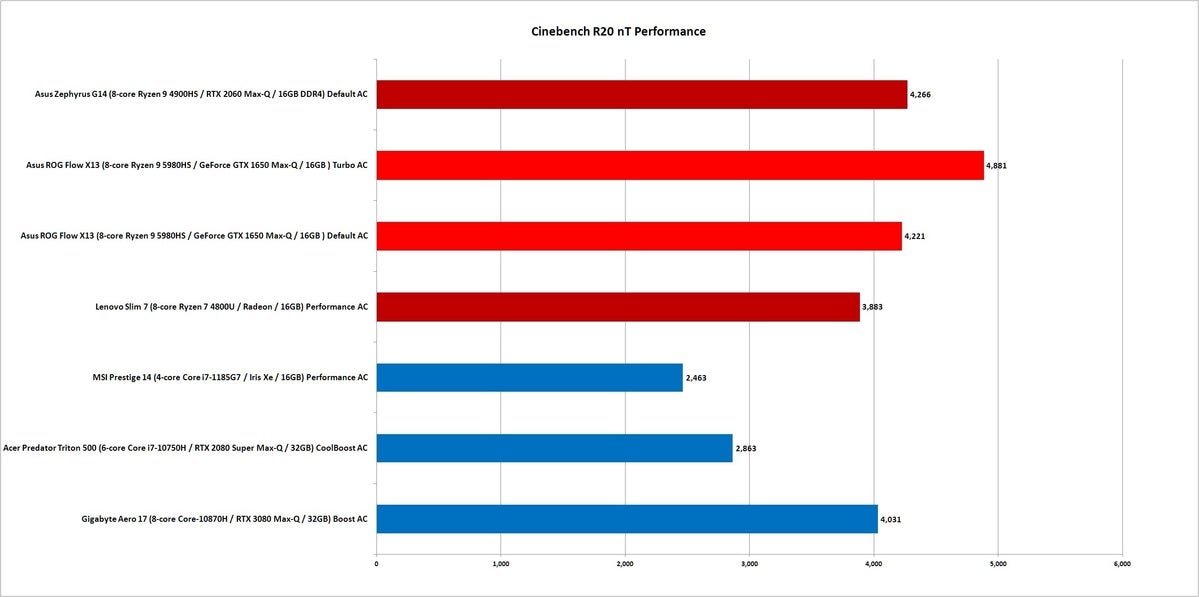
We'll start this hit with Maxon's Cinebench R20. It's the a CPU-based 3D modelling application that is misused in its commercial Cinema4D app. It's also integrated into Adobe products. Many cores and more threads matter in this test, and then non surprisingly, the Ryzen 9 5980HS in the Flow X13–when set to its high "turbo" functioning–is the leader of the pack. It takes a sizeable lead against the Ryzen 9 4900HS in the Zephyrus G14, but more key for AMD, it crushes the new 8-substance Effect i7-10870H in the GB Aorus 17, a big, heavier laptop.
The CPU to pay attention to is the Core i7-1185G7 in the MSI Prestigiousness 14 Evo. Information technology's founded on Intel's newest cores, and although the four-core, low-mightiness version here gets crushed, Intel will soon introduce a higher power H35 version with the same cores and an 8-core H-grade variant.
 IDG
IDG Longer parallel bars indicate better execution
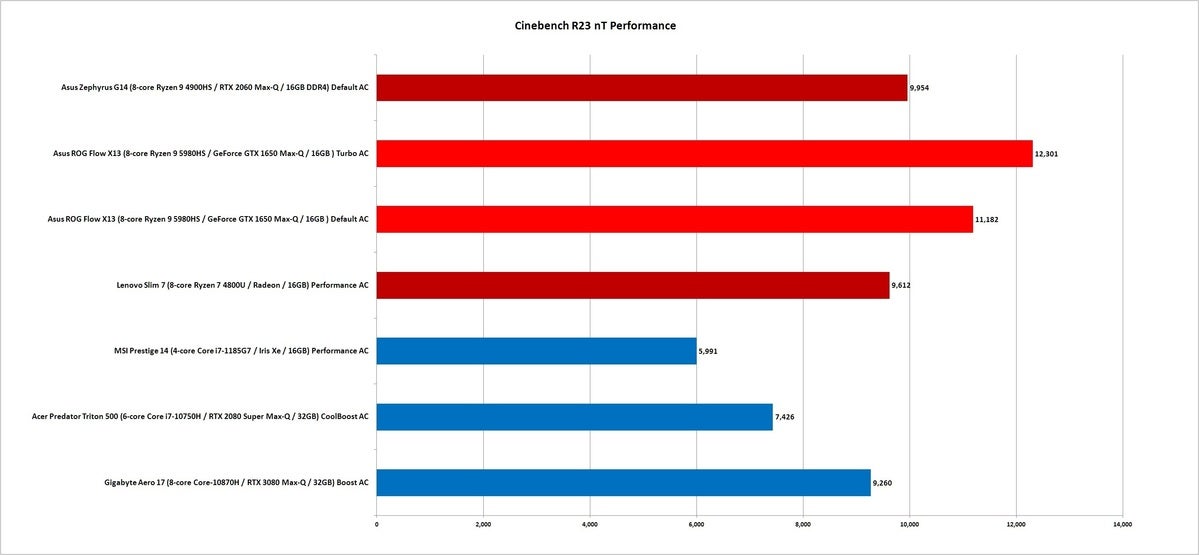
Cinebench R20 uses a slightly older rendering engine from Maxon, just luckily the fellowship has released Cinebench R23 using its latest rendering locomotive. One big change from all early versions of Cinebench is the time information technology takes to scarper. While Cinebench R20 may take two to three minutes to run, Cinebench R23 defaults to 10 minutes-plus, making it many of a stress test than before.
You can see that on a lower floor, where the older 14nm-based Comet Lake H chips lose a little ground against the 7nm Ryzen 4000 and Ryzen 5000. For instance, while the Lapp scene is actually rendered in both versions of Cinebench, going from a 3-minute render to a 10 minutes-plus sees the Ryzen 9 5980HS go from a 21-percent lead over the Congress of Racial Equality i7-10870H in R20, to a 32-percentage lead with R23. Compare that to the newer 10nm 11th-gen Tiger Lake, which maintains mostly single-digit differences between versions.
 IDG
IDG Longer bars point healthier performance
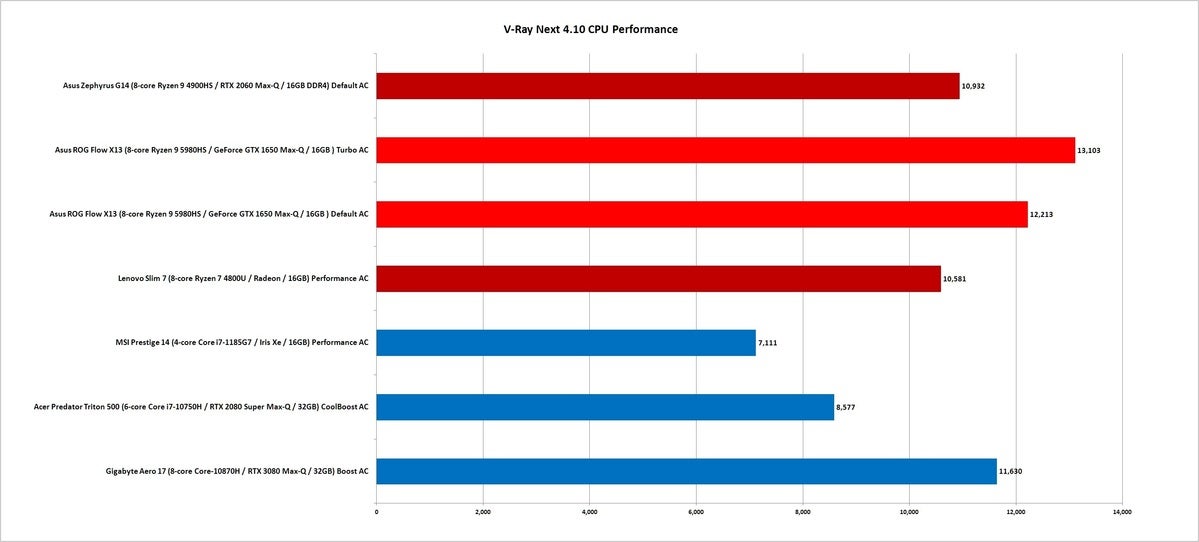
Upfield next is Chaos Group's V-Ray Next, a ray tracing renderer that contributed to Captain America: Civil War and All in Pool. It loves Mainframe threads, and for the virtually part, the tiny Flow X13 leaves the larger laptops in the dust. Ryzen 4000 does fairly well too, merely the Ryzen 9 5980HS excels even connected heavily multi-rib tasks.
 IDG
IDG Longer parallel bars indicate better performance
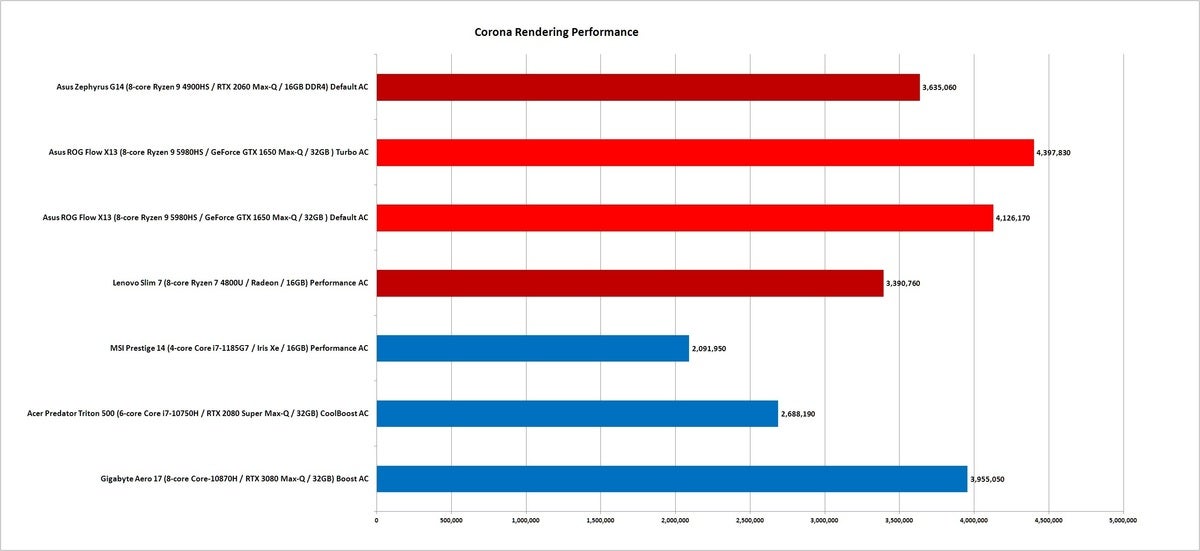
Next up is the Corona discharge Renderer, an unbiased photorealistic renderer. Like any renderer, it loves those cores, and we see yet more test copy that if you really need many cores, the spick-and-span Ryzen 5000 has a decent leg up all over its older siblings as fountainhead As the competitor's CPUs.
 IDG
IDG Longer bars indicate better performance
We could run more multi-threaded molding apps until your eyeballs fell out, just we cogitate even Intel fans would tell the judge that Ryzen has a kernel count advantage, especially when you're comparison Intel's older 10th-gen Comet Lake H chips versus a new Zen 3-based Ryzen 5000. Your Honor, may we ask the criminal prosecution to move onto what counts for most multitude? Single-threaded performance.
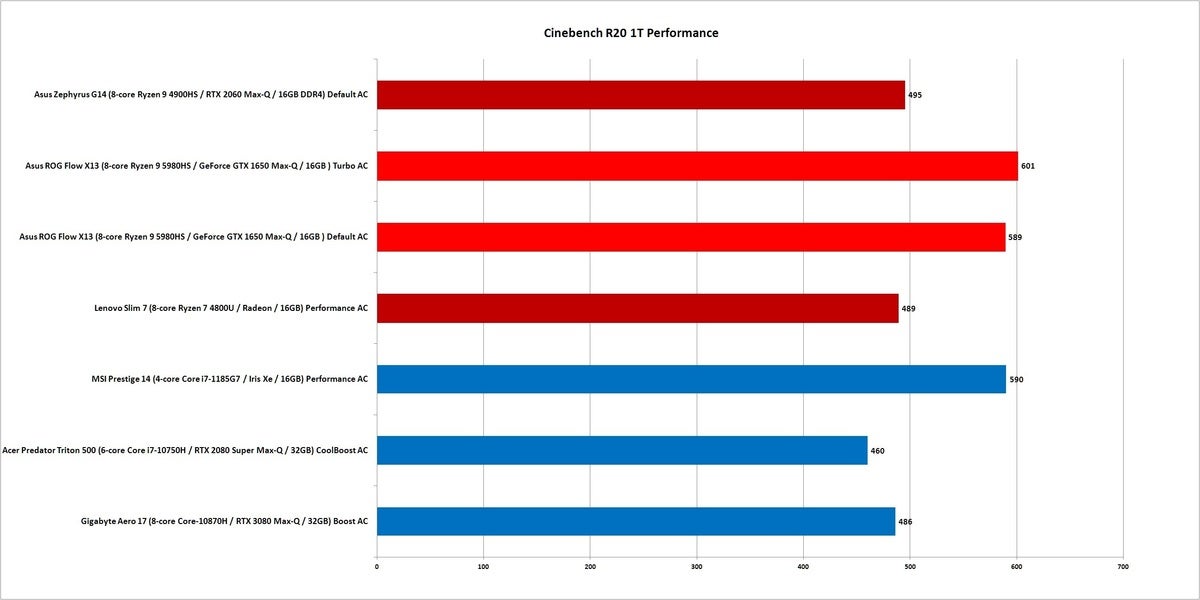
For that, we return to Maxon's Cinebench R20, but set up to use a single-ribbon. The result is impressive. On Turbo, the Ryzen 9 5980HS in the Asus ROG Flow X13 is basically faster than transcribed entries for Core i9-10900K, Ryzen 9 3950X, and Core i9-9900K, and all but dead-even with the Ryzen 5 5600X desktop CPUs.
You detected right: This laptop CPU should basically be as cold as an impressive list of high-performance desktop chips.
 IDG
IDG Longer bars indicate better performance
Compression Performance
We at once take a break from 3D rendering to look at Thomas More common task: file compression. First up is 7-Zip 19.00, a free, best-selling compression tool. You can download 7-Naught, political campaign IT, and be finished in the meter it might take the stock Windows decompress utility to get its act together.
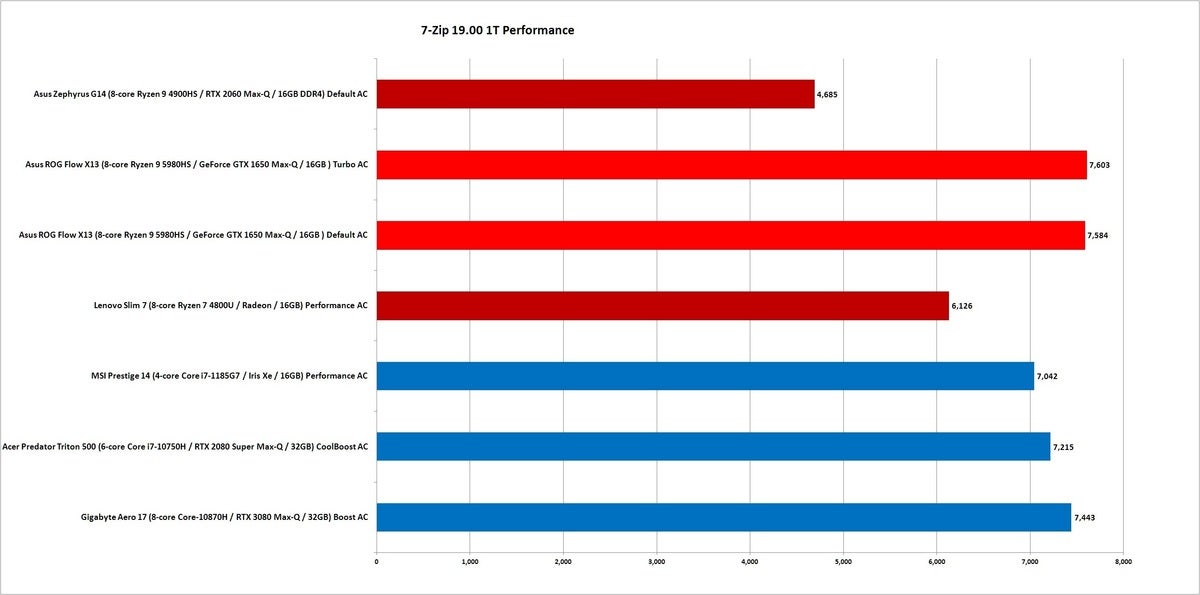
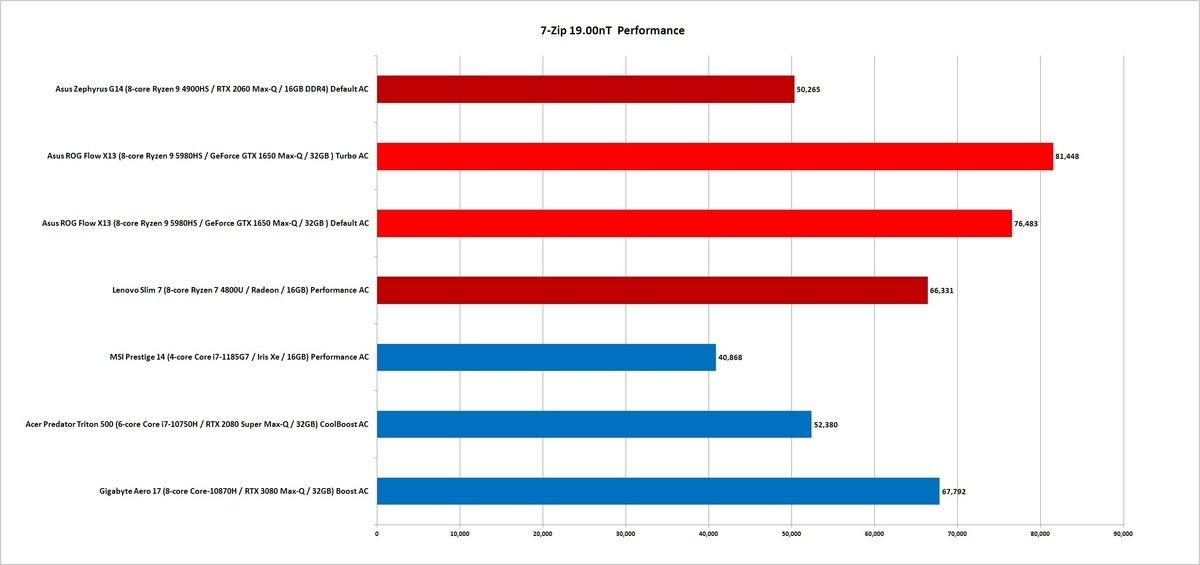
In the unshared-threaded test. 7-Zip tests compression and decompression, which severally vibrat different parts of the CPU and memory subsystem in a PC. You can see that despite the advantage Ryzen 4000 has in 3D modelling, the Ryzen 9 4900HS in the Asus ROG Zephyrus G14 gets trounced. Information technology's hard to say wherefore, but the Ryzen 9 4900HS does have DDR4/3200 RAM, while the Ryzen 7 4800U has LPDDR4x/4266. Because the test is sensitive to memory and squirrel away performance, that difference whitethorn contribute to the Ryzen 4000's disappointing results.
AMD would preferably you flavor at its new Ryzen 5000, which outperforms the three Intel CPUs. That's a good indication of just how swell the Ryzen 9 5980HS might do elsewhere.
 IDG
IDG 7-Zip also features a multi-threaded test, which in this lawsuit gives the edge to the two Ryzen CPUs using LPDDR4x/4266, just that Ryzen 9 4900HS is once again underwhelming. And yes, when you see curious results look-alike this, you re-run the test. We ran the Asus ROG Zephyrus G14 in its Turbo mode, which didn't make much of a difference either.
 IDG
IDG Thirster bars indicate better performance
HandBrake Performance
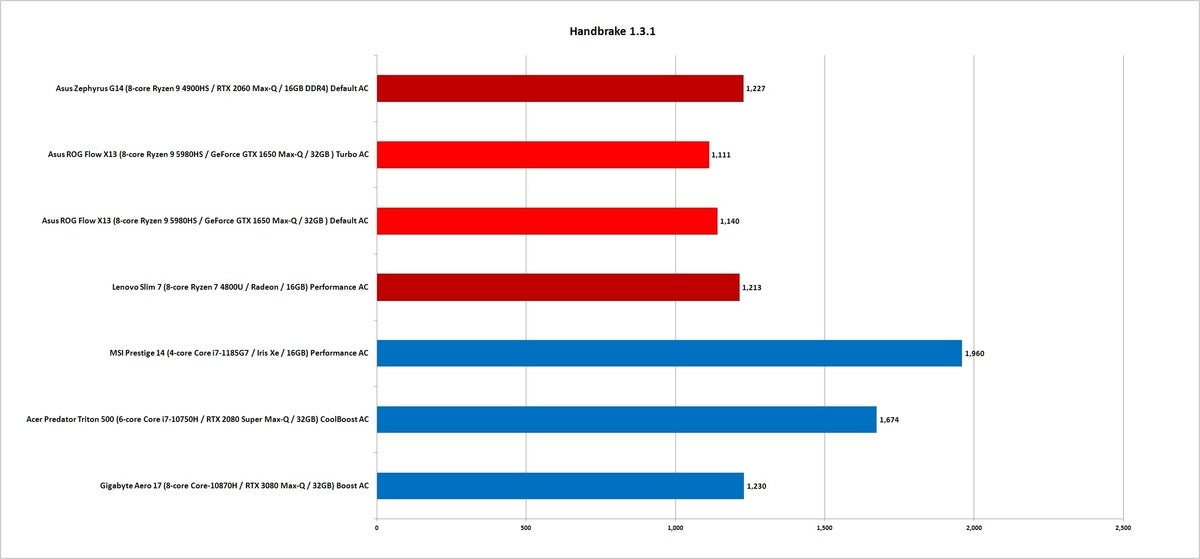
Our next test uses HandBrake 1.3.1 to transcode the open-source 4K Crying of Steel video to 1080p / 30 fps using H.265. The test takes about 20 minutes to complete, and typically to a greater extent cores help (although it doesn't surmount like 3D modelling).
All three Ryzens step up on top, led–barely–by the Ryzen 9 5980HS. Information technology doesn't crush the Core i7-10870H the way you might wait it to, merely you should remember that it's a three-pound laptop computer as well with far more limited cooling.
Intel fans, don't get too rowdy. It's actually not very good when a Ryzen 7 4800U in the Lenovo Yoga Slim 7 in essence breaks even with a Core i7-10870H chip. The 11th-gen Tiger Lake doesn't look too hot either, with its mere Little Jo cores.
 IDG
IDG Shorter bars argue wagerer carrying into action
Office 365 Performance
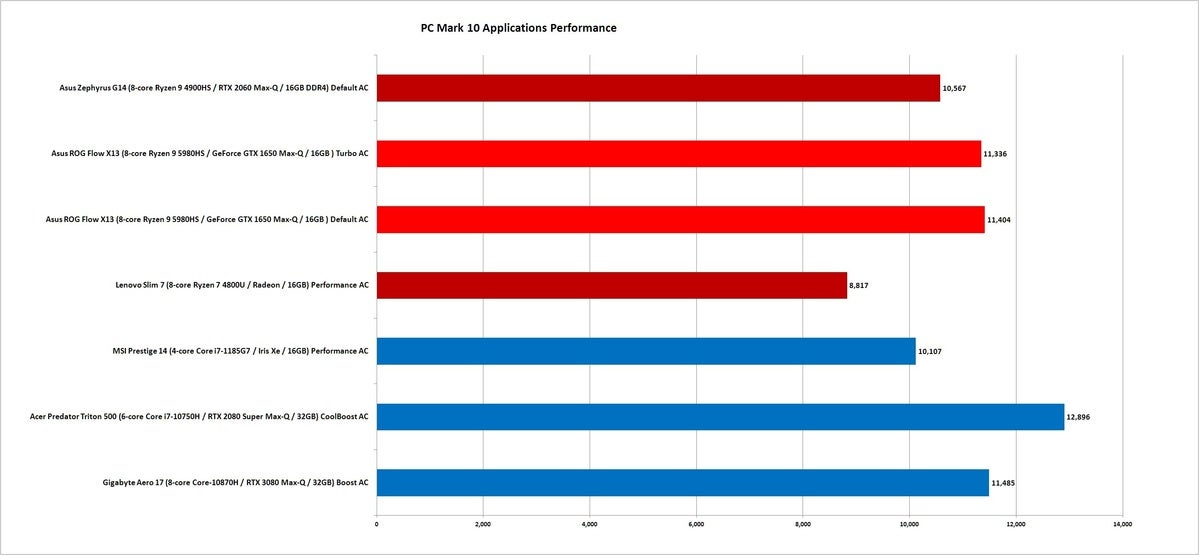
We use UL's PCMark 10 Application test which tasks Microsoft Power 365's News, Stand out, PowerPoint, and March with all the boring simply valued things any office drone would bash. We'd interpret this to be generally a tie.
Looking at the subscores for the applications (not shown), we commode tell you the laptops with to a greater extent cores seem to have an edge in Excel. The rack up for the Heart and soul i7-10750H in the Acer Predator Newt 500 confused us, just it's possible that one laptop had a slightly different version of Edge installed. The laptops with discrete GPUs all profited in this test, suggesting that GPUs may matter regular to Office 365, finally.
The simple fact that AMD can stand with Intel in lighter-duty work is a good thing.
 IDG
IDG Longer parallel bars indicate better performance
Adobe Yeasty Sully Carrying out
Moving on to a heavier workload, we use workstation builder Puget System's PugetBench to overestimate how these laptops practice using Adobe's popular Inventive Sully. One parole of carefulness: In some all mental testing above, the results were mostly focused on the CPU performance. As a living, breathing, organic fertiliser and vast application suite, Adobe touches just almost everything happening a PC, and those with faster GPUs typically have an advantage.
Premiere Operation
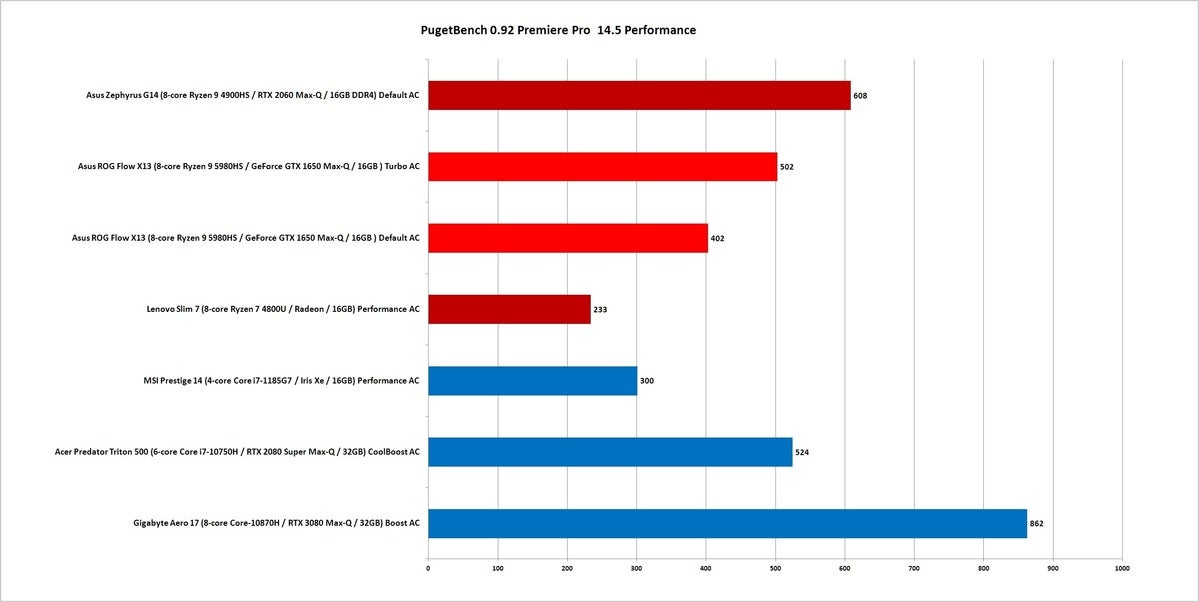
Ascending first is PugetBench for Adobe Premiere (we examined PugetBench in contingent recently). As you can see from the results, Premiere likes a compounding of a dissolute CPU with to a greater extent cores, and perhaps to a greater extent importantly, a very fast GPU.
And yes, that new-sprung Nvidia GeForce RTX 3080 GPU is no laugh. Concerted with the evilly fast GPU, the 8-core Core i7-10870H is clearly the best laptop present for Adobe Premiere work.
Heart and soul count matters, too. Justified tthough the Acer Predator Triton 500 packs a GeForce RTX 2080 Super, its 6-core Substance i7-10750H is promising putt it behind the Asus ROG Zephyrus G14 with its 8-core Ryzen 9 4900HS and GeForce RTX 2060.
Of pursuit here is the Asus Flow X13 and its 8-core group Ryzen 9 5980HS. Set to Turbo, with its modest aboard GeForce GTX 1650, it just about matches the Genus Acer Predator Triton 500.
Once we finally get our hands on the Asus XG Mobile with its GeForce RTX 3080, we'll rerun this test to find out to see where the Flow X13lands with a faster GPU.
 IDG
IDG Longer bars indicate better functioning
Photoshop Public presentation
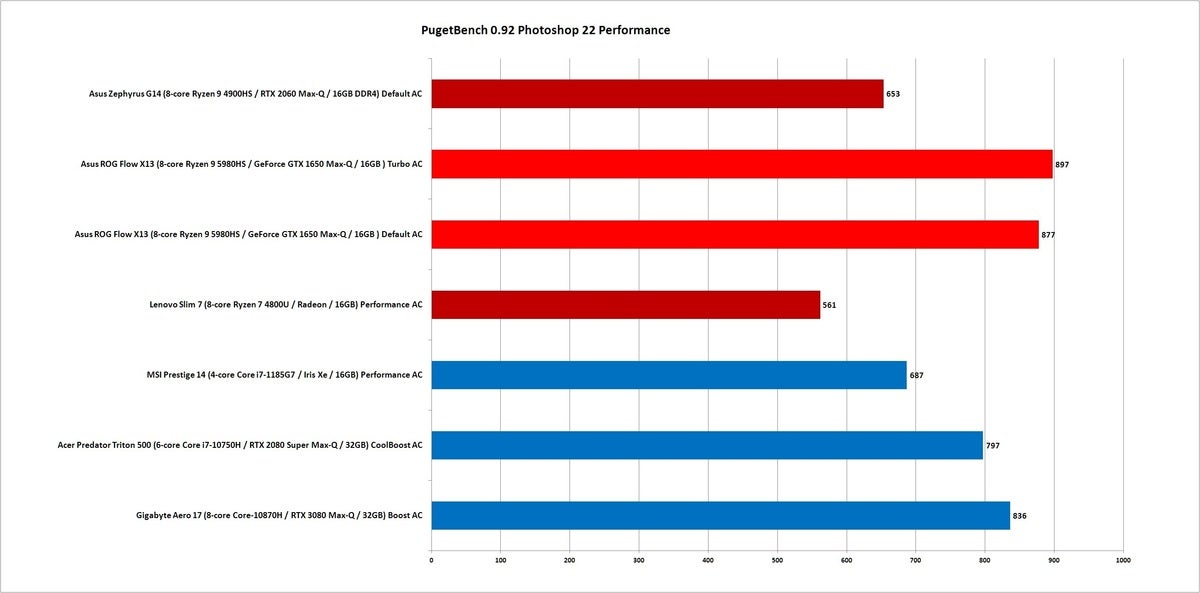
Up next is the application so implanted in society that mass say "Photoshop it" to miserly they edit a photo. We again use Puget Systems PugetBench, which actually recommends 32GB of RAM for reliable dozens. Despite this testimonial, we've establish it to be fairly reliable on 16GB of Read/write memor.
Unlike Premiere, Photoshop doesn't typically leverage the GPU atomic number 3 to a great extent, but IT's still difficult to separate the cardinal in results. When not leaning happening the GPU, it's mostly gently rib work, and CPUs with high efficiency and highschool clock speeds matter. We've also found indications of customization that favor's Intel's newest chips.
The results here are nothing but good for AMD and Ryzen 5000. Again, it's difficult to separate GPU from CPU, but we send away say that the three- pound ROG Flow X13 and Ryzen 9 with GeForce GTX 1650 can outperform much quicker GPUs and equal Congress of Racial Equality-count CPUs from Intel.
 IDG
IDG Longer parallel bars suggest better performance
Lightroom Classic Performance
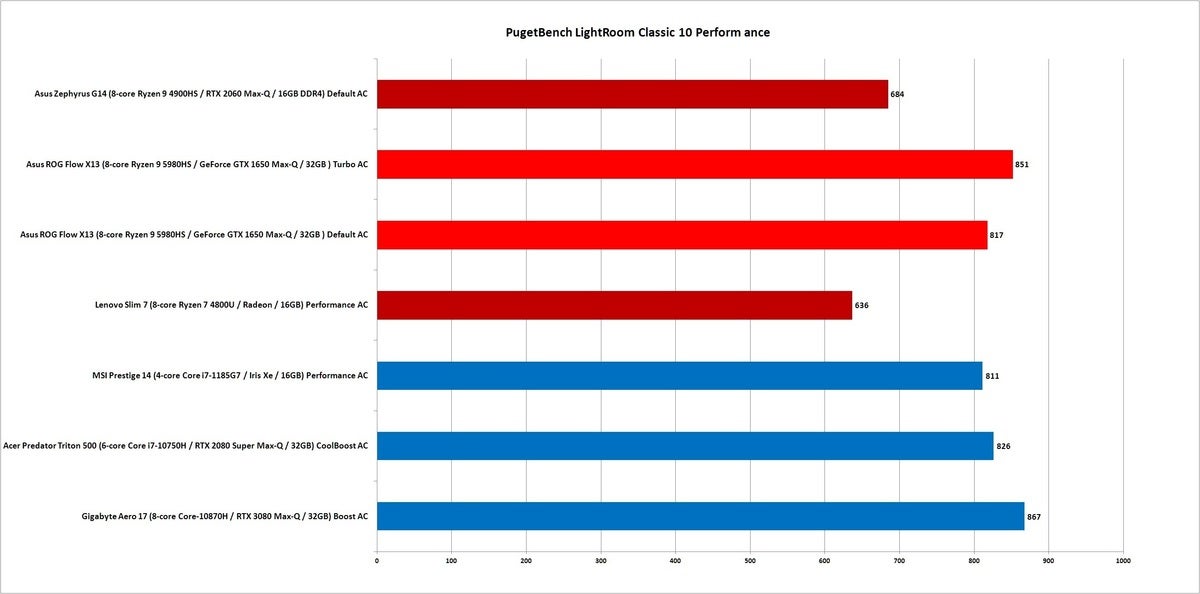
Our antepenultimate PugetBench/Adobe brick trial uses Lightroom to churn through hundreds of In the raw files. Of the three apps, it seems less leveraged on the GPU, so we get a better smel for how the laptops and chips stack astir. We'd basically phone call this a tie which, from AMD's ponit of view, is a good thing. Some of the Ryzen 4000 laptops shoe a small disadvantage against both Panthera tigris Lake and Comet Lake. Ryzen 5000 and Zen 3 close the gap enough to make the difference negligible.
 IDG
IDG Longer bars indicate better carrying out
Topaz Gigapixel Three-toed sloth
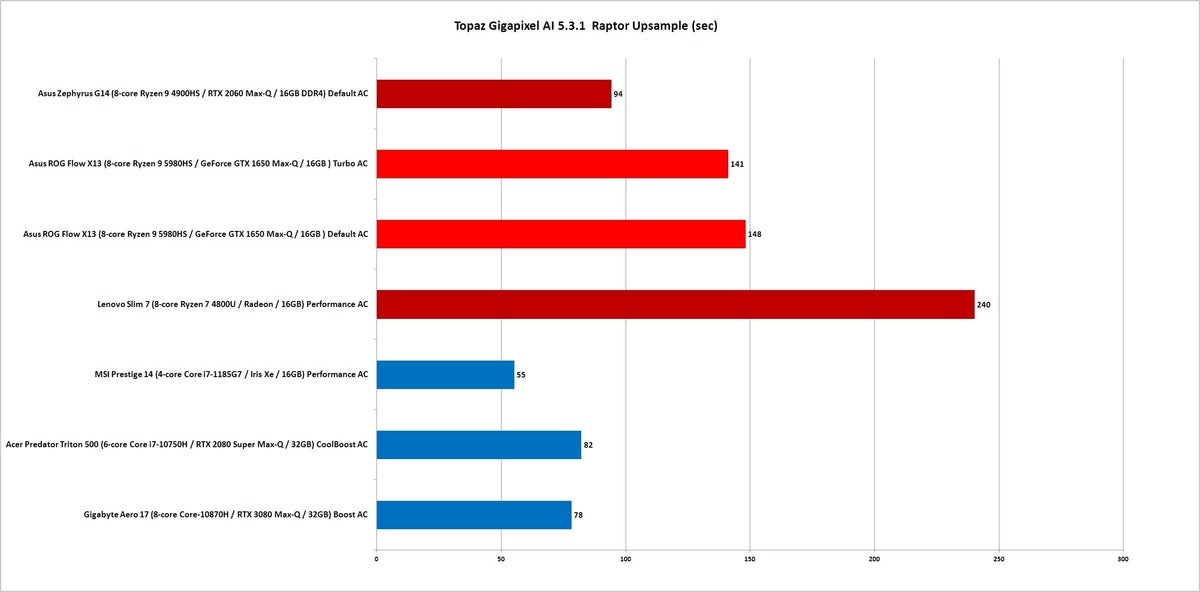
Our ultimate trial ventures into the undaunted new world of AI. Intel's 11th-gen CPUs all feature some form of AI acceleration under the umbrella of DL Boost. IT may seem esoteric, but it can be very impressive. Topaz Research laboratory's Gigapixel Bradypus tridactylus takes advantage of it to flesh out photos in a manner far better than traditional upscaling methods. For our run, we use Gigapixel AI 5.3.1 to execute a 6X enlargement happening an 8MP photo of an F-22 Raptor crazy a Canon 1D MK IIn. It's an entirely existent use case for soul looking to get more life retired of an 10-twelvemonth-sometime photo they love. Gigapixel AI uses Intel's OpenVINO framework, which runs happening all CPUs–simply if you take over a CPU that accelerates it, you save a packet of time. For laptops with discrete GPUs, Gigapixel allows you to keep going the graphics subsystem using OpenGL.
The quickest laptop here is the MSI Prestige 14 Evo with Core i7-1185G7 and Iris diaphragm Xe nontextual matter. That's despite having four cores, no discrete graphics, and a very lean power and thermal budget. The only laptops that stand a chance against it are those with fast distinct graphics. Here's one place where, at to the lowest degree right now, Intel has a very medium-large advantage.
 IDG
IDG A shorter bar indicates better performance
Ryzen 5000 airborne conclusion
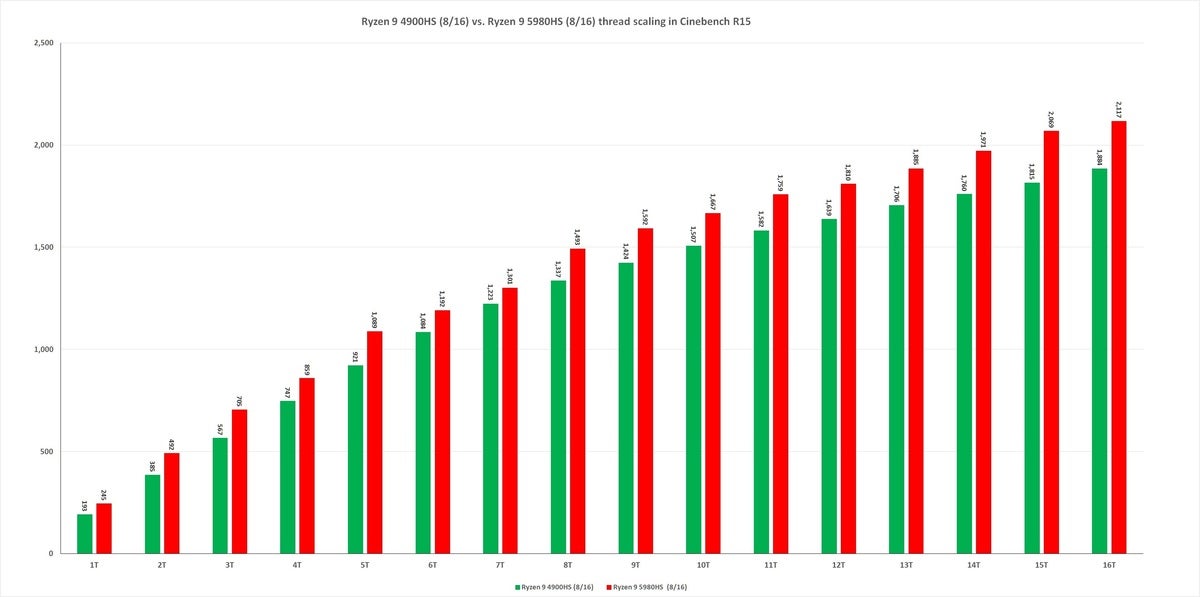
We'll close out our review away look how considerably the Ryzen 5000 scales from light loads to heavy stacks. While it's based on an older 3D modeling application which may not necessarily represent all workloads, we guess it's a nifty way to visualize just where the strengths of the new chip are.
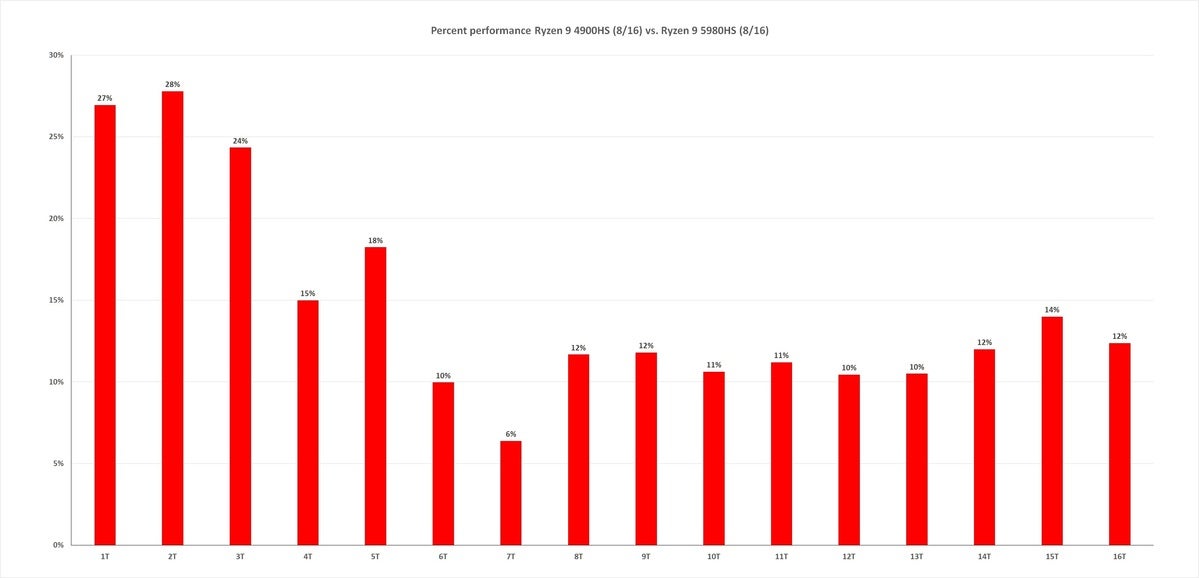
We take Cinebench R15 and run it from a single thread to the maximum of threads connected each Central processor. Below we compare the Ryzen 9 4900HS to the Ryzen 9 5980HS.
 IDG
IDG Longer bars indicate better performance
For a different tip over (below), we look at the same data as percent difference of opinion. On the correctly side of the chart below, the Ryzen 5000 typically outperforms the Ryzen 4000 by 10 to 12 percent. Ryzen has already incontestible its lead in multi-core, indeed the work on the left side of the graph is what matters more. There we see the Ryzen 5000 turn in far greater leads over its predecessor. So yes, mission effected.
 IDG
IDG Longer bars signal better carrying into action
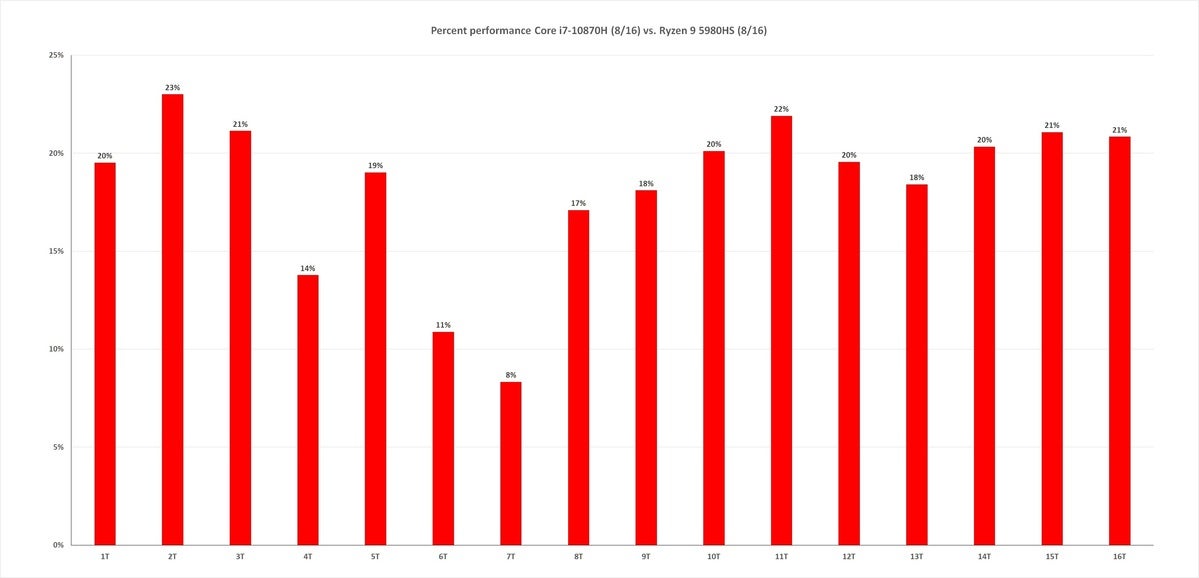
Next we comparability the 8-core Ryzen 9 5980HS to the 8-core Core i7-10870H. Arsenic you put up see on a lower floor, it's across-the-board outpacing the Kernel i7-10870H, with a 20-percentage lead in a single thread, and 22 percent with 16 threads.
 IDG
IDG Yearner bars point bettor performance
Remember, the Ryzen 9 5980HS is accomplishing this in a three-pound convertible laptop versus a six-pound gaming laptop.
We're not entirely certain Ryzen 5000 will scale up equally you put it into fatter laptops with healthier cooling and more power—but we do know you rump't squeeze Intel's current 14nm 8-core CPUs into laptops this thin, nor this light. For now, Ryzen 5000 is the ruler of all it sees.
 AMD
AMD Source: https://www.pcworld.com/article/393988/ryzen-5000-mobile-review-amd-wins-big-in-laptops.html
Posted by: riveracamortautley.blogspot.com
0 Response to "Ryzen 5000 review: AMD wins big in laptops - riveracamortautley"
Post a Comment